

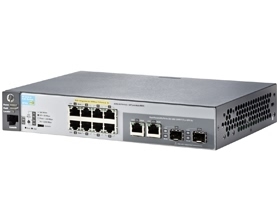
Hp 2530-8-poe+ Switch J9780a
| SKU: | 186966 |
|---|---|
| MPN: | J9780A |
| Manufacturer: | http://www8.hp.com/au/en/home.html |
| Brand: | Hp |
| Availability: |
Preorder 2-3 weeks |
| Fright Estimate |

Description
The HP 2530 Switch Series consists of 12 fully managed Layer 2 edge switches
that deliver cost-effective, reliable, secure, and easy-to-use connectivity to
business networks. Designed for entry-level to midsize enterprise networks,
these Gigabit and Fast Ethernet switches deliver full Layer 2 capabilities with
optional PoE+, enhanced access security, traffic prioritization, and IPv6 host
support.
The HP 2530 Switch Series offers uplink flexibility with four Gigabit Ethernet
uplinks on all 24- and 48-port models. Gigabit Ethernet uplinks are four small
form-factor pluggable (SFP) slots for fiber connectivity on the 24- and 48-port
Gigabit Ethernet models.
The Fast Ethernet 24- and 48-port models have two SFPs and two RJ-45 Gigabit
uplinks. The compact and fanless 8-port switches offer additional flexibility
with two dual-personality ports that can be used as either RJ-45 Gigabit
Ethernet or SFP ports.
For customers implementing Power over Ethernet for voice, video, or wireless
deployments, the HP 2530 PoE+ switches are IEEE 802.3af and IEEE 802.3at
compliant with up to 30 W per port. The switch series is easy to use, deploy,
and manage via SNMP, CLI, and Web GUI.
It offers flexible wall, table, and rack mounting; quiet operation with fanless
and variable speed fan models; and improved power savings, with features such as
IEEE 802.3 az (Energy Efficient Ethernet). These switches include a lifetime
warranty, as well as all software releases and technical phone support.
Features
Quality of Service (QoS)
Traffic prioritization (IEEE 802.1p): allows real-time traffic classification
with support for eight priority levels mapped to either two or four queues; uses
weighted deficit round robin (WDRR) or strict priority (SP)
Simplified QoS configuration: Port-based: prioritizes traffic by specifying a
port and priority level. VLAN-based: prioritizes traffic by specifying a VLAN
and priority level.
Class of Service (CoS): sets the IEEE 802.1p priority tag based on IP address,
IP Type of Service (ToS), Layer 3 protocol, TCP/UDP port number, source port,
and DiffServ
Rate limiting: sets per-port ingress enforced maximums for all ingressed traffic
or for broadcast, multicast, or unknown destination traffic
Layer 4 prioritization: enables prioritization based on TCP/UDP port numbers
Management
Choice of management interfaces: Web graphical user interface (GUI): HTML-based
easy-to-use graphical interface allows configuration of the switch from any Web
browser. Command-line interface (CLI): provides advanced configuration and
diagnostics through a robust CLI. Simple Network Management Protocol
(SNMPv1/v2c/v3): allows a switch to be managed with a variety of third-party
network management applications.
Virtual stacking: provides single IP address management for up to 16 switches
sFlow (RFC 3176): delivers wire-speed traffic accounting and monitoring
configured by SNMP and CLI with three terminal encrypted receivers
IEEE 802.1AB Link Layer Discovery Protocol (LLDP): automates device discovery
protocol for easy mapping by network management applications
Logging: provides local and remote logging of events via SNMP (v2c and v3) and
syslog; provides log throttling and log filtering to reduce the number of log
events generated
Connectivity
IPv6: IPv6 host: allows the switch to be deployed and managed at the edge of an
IPv6 network. Dual stack (IPv4/IPv6): supports connectivity for both protocols;
provides a transition mechanism from IPv4 to IPv6. MLD snooping: forwards IPv6
multicast traffic to the appropriate interface; prevents IPv6 multicast traffic
from flooding the network.
IEEE 802.3af Power over Ethernet (PoE): provides up to 15.4 W per port to IEEE
802.3af-compliant PoE-powered devices such as IP phones, wireless access points,
and security cameras
IEEE 802.3at Power over Ethernet Plus: provides up to 30 W per port to IEEE
802.3 for PoE/PoE+-powered devices such as video IP phones, IEEE 802.11n
wireless access points, and advanced pan/tilt/zoom security cameras (see product
specifications for total PoE power available)
Auto-MDIX: adjusts automatically for straight-through or crossover cables on all
ports
Pre-standard PoE support: detects and provides power to pre-standard PoE
devices; see the list of supported devices in the product FAQ at
www.hp.com/networking/support
Layer 2 switching
VLANs: provides support for 512 VLANs and 4,094 VLAN IDs
Jumbo packet support: supports up to 9220-byte frame size to improve the
performance of large data transfers; 8- and 24-port Fast Ethernet models
automatically support up to 2000-byte frames with no configuration needed
16K MAC address table: provides access to many Layer 2 devices
GARP VLAN Registration Protocol: allows automatic learning and dynamic
assignment of VLANs
Per-VLAN Spanning Tree Plus (PVST+): allows each VLAN to build a separate
spanning tree to improve link bandwidth usage in network environments with
multiple VLANsPorts
8 RJ-45 autosensing 10/100 PoE+ ports (IEEE 802.3 Type 10BASE-T, IEEE 802.3u
Type 100BASE-TX, IEEE 802.3at PoE+)
Media Type: Auto-MDIX
Duplex: half or full
2 dual-personality ports
each port can be used as either an RJ-45 10/100/1000 port (IEEE 802.3 Type
10Base-T
IEEE 802.3u Type 100Base-Tx
IEEE 802.3ab 1000Base-T Gigabit Ethernet) or as a SFP slot (for use with SFP
transceivers) ports
1 dual-personality (RJ-45 or USB micro-B) serial console port
Included
Memory and processor
ARM9E @ 800 MHz; 128 MB flash; packet buffer size: 1.5 MB dynamically allocated;
256 MB DDR3 DIMM
Latency
100 Mb Latency: < 1.3 µs
1000 Mb Latency: < 2.3 µs
Throughput
4.1 million pps
Switching capacity
5.6 Gb/s
PoE capability
67 W
Management features
IMC - Intelligent Management Center
command-line interface
Web browser
configuration menu
out-of-band management (serial RS-232C or Micro USB)
IEEE 802.3 Ethernet MIB
Repeater MIB
Ethernet Interface MIB
Power and operating requirements
Power consumption
76.7 W (maximum)
Input voltage
100 - 127 / 200 - 240 VAC
Operating temperature range
0 to 45?C
Operating humidity range
15 to 95% @ 104?F (40?C) (noncondensing)
Heat dissipation
29 BTU/hr (30.6 kJ/hr)
Dimensions and weight
Minimum dimensions (W x D x H)
25.4 x 15.95 x 4.45 cm
Weight
0.91 kg
What's included
Differentiator
The HP 2530-8-PoE+ Switch is a fully managed layer 2 switch with 8 10/100 PoE+
ports and 2 dual personality ports.
What's in the box
(1) HP 2530-8-PoE+ Switch
Warranty
Lifetime, advance replacement, next business day, phone support, software
releases
Vendor Info
| Marketing Text | The HP 2530 Switch Series consists of 12 fully managed Layer 2 edge switches that deliver cost-effective, reliable, secure, and easy-to-use connectivity to business networks. |
| PI Date | Oct 2013 |
| Brand Name | HP |
| Manufacturer Web Site | http://www.hp.com |
| Form Factor | 1U |
| Product Model | 2530-8-PoE+ |
| Product Type | Standalone Switch |
| Mac Address | 16kentries |
| Forwarding Rate | 4.1Mpps |
| Packet Buffer | 1.5MB |
| Switching Fabric | 5.6Gbps |
| Jumbo Frame Size | 9220Bytes |
| Expansion Ports | 2 x Dual Personality |
| Fast Ethernet Port | Yes |
| No. of Ports | 8 |
| Type | 10/100Base-TX |
| Other Port | 1 x Console Port |
| Virtual LAN | * VLAN-based prioritize traffic by specifying a VLAN and priority level * VLANs provides support for 512 VLANs and 4,094 VLAN IDs * Voice VLAN uses LLDP-MED to automatically configure a VLAN for IP phones |
| Management Features | * IMC - Intelligent Management Center * Command-line interface * Out-of-band management (serial RS-232C or Micro USB) * IEEE 802.3 Ethernet MIB * Ethernet Interface MIB |
| Security Features | * Access control lists (ACLs) * Source-port filtering * RADIUS/TACACS+ * Secure Sockets Layer (SSL) * Port security * MAC address lockout * Multiple user authentication methods * IEEE 802.1X * Web-based authentication * MAC-based authentication * Secure shell (SSHv2; client and server) * Secure shell * STP BPDU port protection |
| Quality of Service (QoS) | * Traffic prioritization (IEEE 802.1p) * Simplified QoS configuration * Port-based * VLAN-based * Class of Service (CoS) * Rate limiting * Layer 4 prioritization * Flow control |
| Output Power | 76.7Watt |
| Depth (mm) | 159.5 |
| Height (mm) | 44.5 |
| Width (mm) | 254.0 |
| Weight (Kg) | 0.9 |
| Layer Support | 2 |
| Management | Managed |
| RAM Installed | 256MB |
| Flash Memory | 128MB |
| Network Technology | 10/100Base-TX |
| Other Features | * 8 RJ-45 autosensing 10/100 PoE+ ports (IEEE 802.3 Type 10BASE-T, IEEE 802.3u Type 100BASE-TX, IEEE 802.3at PoE+) Media Type: Auto-MDIX, Duplex: half or full * 2 dual-personality ports each port can be used as either an RJ-45 10/100/1000 port (IEEE 802.3 Type 10Base-T IEEE 802.3u Type 100Base-Tx IEEE 802.3ab 1000Base-T Gigabit Ethernet) or as a SFP slot (for use with SFP transceivers) ports * 1 dual-personality (RJ-45 or USB micro-B) serial console port * Latency : 100 Mb Latency: 1.3 µs (LIFO 64-byte packets), 1000 Mb Latency: 2.3 µs (LIFO 64-byte packets) |
| PoE Enabled | Yes |
